
Herbarium of Trenton guides
- Folder
- Healthy Home & Yard
- Sheet
- No. 09 of 12
- Read
- 4 min
Collector’s notes
- Water leaving Trenton Water Works’ filtration plant is lead free; lead comes from service lines and home plumbing.
- New Jersey requires all lead service lines to be removed by 2031.
- Boiling water does not remove lead.
Trenton Water Works, one of the nation’s oldest public water systems, draws its water from the Delaware River and treats it at its filtration plant. The utility says that when water leaves the plant it is lead free. Lead gets into Trenton tap water later, from the pipes that connect homes to the street and from the plumbing inside older buildings.
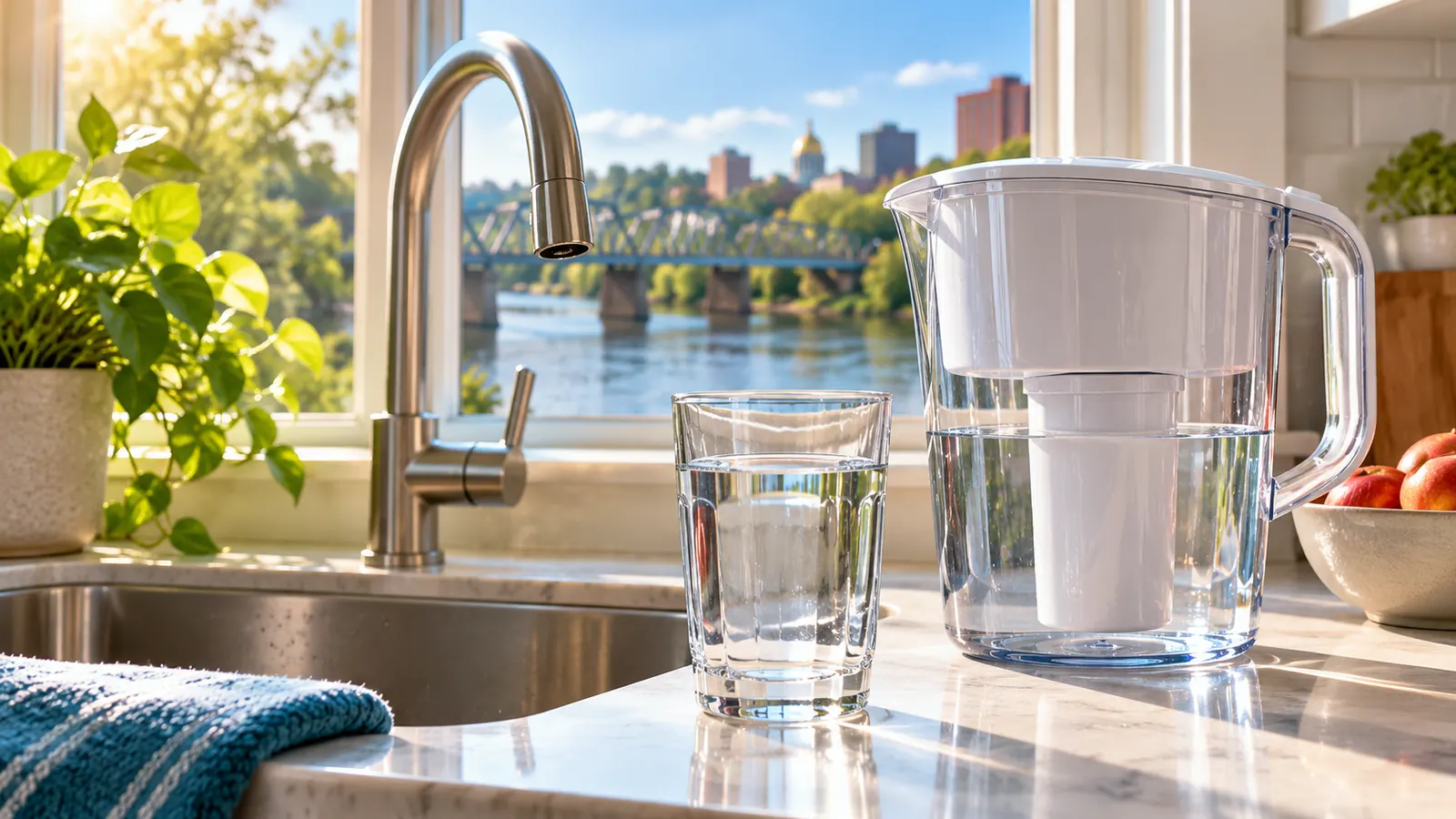
Where the lead comes from
The utility’s lead program FAQ explains that the water mains under the street are made mostly of iron and steel and do not add lead. The problem is the service line, the pipe that carries water from the main into a building, and indoor plumbing. In Trenton, lead was commonly used for service lines until 1960 and for indoor plumbing and solder until 1986, when it was banned. Between 1986 and 2014, faucets and other fixtures could contain up to 8 percent lead and still be sold as lead free; current standards allow no more than 0.25 percent.
When water sits in a lead line or old plumbing for several hours, overnight or during a workday, lead can dissolve into it. Pregnant women, infants and young children are especially at risk, and the FAQ is direct about the threshold: no level of lead is considered safe for consumption.
Who owns your service line
Ownership is split. Trenton Water Works owns the line from the main in the street to the curb stop, the street side. The property owner owns the line from the curb stop to the meter inside the home, the meter side. Older programs only replaced the utility’s half, which is why the current program replaces the whole line.
Check your own line in five minutes
The utility’s guide to finding out whether you have a lead service line needs only a house key or coin and a magnet:
- Find the water meter on your property.
- Find the pipe that comes through the outside wall and connects to the meter.
- Gently scratch the pipe with the key or coin, like a lottery ticket. Lead is dull gray but turns bright silver when scratched. If the pipe is painted, sand a small spot first. Do not use a knife or puncture the pipe.
- Hold the magnet to the pipe. It sticks only to galvanized steel, not to copper, lead or plastic.
- If you think you have a lead or galvanized line, report it with your address and photos.
Galvanized steel is gray, magnetic and makes a metallic sound when tapped. The utility warns that galvanized pipe may be lead-lined, and that even a non-lead galvanized line may connect to a lead gooseneck in the street.
The replacement program
Trenton Water Works launched its Lead Service Line Replacement Program in 2019. According to the City, the utility has since invested $70 million to remove more than 11,000 lead service lines from its system and private homes at no cost to property owners. Making the program free and mandatory received state approval and was enacted by municipal ordinance for all customers in the service area. Replacing a line typically costs between $5,000 and $10,000 per property.
There is no sign-up list. Every property confirmed to have a lead service line is eligible, subject to funding and to municipal road-paving schedules. As of August 2025, about 20,000 properties with known lead service lines remained in the system, and New Jersey requires all water utilities to remove all lead infrastructure by 2031. The utility’s stated goal is to remove all of it from its system by that year, as part of a $175 million, multi-year program.
Customers can check what the utility has on record for their property at twwleadprogram.com, which also has a self-survey tool for uploading well-lit photos of a service line when the material is unknown.
| Lead program contact | Details |
|---|---|
| Program website | twwleadprogram.com |
| Phone | 609-989-3055 |
| twwleadprogram@trentonnj.org | |
| Health questions | City of Trenton Health Department, (609) 989-3331 |
Safer habits until then
The utility’s FAQ and its water quality page recommend the same steps:
- Use only cold water for drinking, cooking and preparing baby formula. Hot water dissolves more contaminants.
- Run the cold tap until it feels cold when water has sat for hours; the utility’s water quality page suggests about two minutes, or use laundry, showers and flushing to move fresh water into the pipes.
- Do not boil water to remove lead. Boiling does not remove it and can concentrate it.
- Clean faucet screens and aerators regularly.
- Use a filter certified by NSF to remove lead, and replace cartridges on schedule.
- Replace old fixtures with ones meeting the 0.25 percent lead-free standard.
Tip: After a lead line is replaced, disturbed pipes can raise lead levels for a short time. The utility asks residents to remove aerators and run every cold tap for 30 minutes, starting at the lowest level of the home, then ask TWW about testing.
Lead from other sources
Water is one route among several. Old paint is often the bigger risk for young children; see Lead Paint and Children in New Jersey: Testing, Trenton’s Lead Program and the Rental Inspection Rule. For where Trenton’s water comes from in the first place, see The Delaware River at Trenton: Where the Tide Begins and How High the River Has Risen.