
Herbarium of Trenton guides
- Folder
- Recycle & Dispose
- Sheet
- No. 02 of 12
- Read
- 4 min
Collector’s notes
- Mercer County holds three household hazardous waste days in 2026: March 21, June 13 and September 26.
- Oil-based paint is accepted; latex paint is not.
- The EPA says never to mix leftover household chemicals.
Key takeaways
- Hazardous waste is collected on set days, not at the curb.
- 2026 dates: March 21, June 13 and September 26, 8 a.m. to 2 p.m., in Lawrence Township.
- Keep products in their original labeled containers and never mix them.
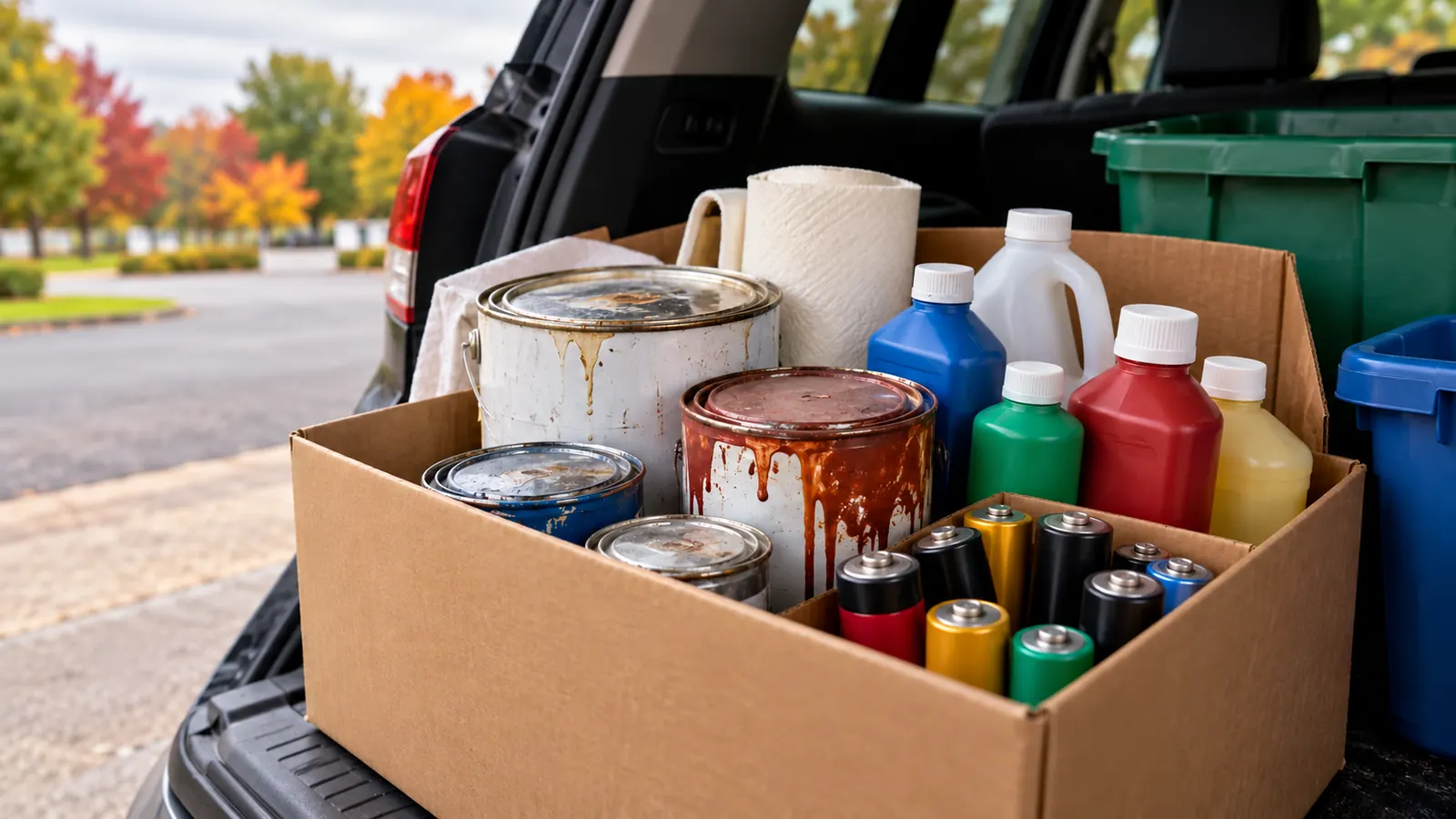
Most homes in Trenton hold a small stockpile of chemicals: half a can of paint thinner, a bug spray from three summers ago, a propane cylinder from the grill. None of it belongs in the garbage, down the drain or in a storm drain. Mercer County runs collection days for exactly these products, and they are free for county residents.
The 2026 collection days
The Mercer County Improvement Authority hosts three household hazardous waste events a year. In 2026 they fall on Saturday, March 21, Saturday, June 13 and Saturday, September 26, from 8 a.m. to 2 p.m., at the Dempster Fire Training School, 350 Lawrence Station Road in Lawrence Township. The county’s 2026 calendar lists electronics recycling at the same events.
What they accept
Lawrence Township, which hosts the site, publishes the list of products Mercer County residents may bring:
- Aerosol cans
- Used motor oil
- Propane gas tanks
- Pesticides and herbicides
- Car batteries
- Paint thinner
- Oil-based paint (no latex paint)
- Stains and varnishes
- Gasoline
- Antifreeze
- Driveway sealer
- Insect repellents
- Mercury
- Fluorescent and CFL bulbs
Latex paint is the item people most often bring by mistake. It is specifically excluded from the list. Check the label: water cleanup usually means latex, while thinner or mineral spirits cleanup usually means oil-based.
Why these products need special handling
The U.S. Environmental Protection Agency describes household hazardous waste as leftover products that can catch fire, react or explode under certain circumstances, or that are corrosive or toxic. Paints, cleaners, oils, batteries and pesticides are typical examples. The agency lists pouring them down the drain, onto the ground, into storm sewers or in some cases out with the regular trash as improper disposal.
The harm is not always visible. EPA notes that these wastes can injure sanitation workers, contaminate septic tanks and wastewater treatment systems when poured down drains or toilets, and pose a danger to children and pets when left around the house. In Trenton, storm drains lead to the Delaware River, the Delaware and Raritan Canal or local creeks, as explained in Storm Drains and Stormwater in Trenton: Where Rain Goes and What Should Never Follow It.
Storing products until collection day
With only three events a year, most households store something for a few months. EPA’s handling advice is simple and worth following exactly:
- Keep products in their original containers and never remove labels.
- Never store hazardous products in food containers.
- Never mix leftovers; incompatible products can react, ignite or explode.
- Treat empty containers with care, because residues remain.
- For a corroding container, call your local hazardous materials official or the fire department for instructions.
A sturdy box in a cool garage or shed, away from children and pets, is a good holding place. Keep propane tanks outdoors and upright.
Getting them there safely
On collection day, pack containers upright in a box lined with an old towel, close every lid tightly and keep the box in the trunk or truck bed rather than the passenger area. Read the labels before you go; EPA points out that product labels often carry disposal directions that reduce the risk of leaks, fires or chemical mixing on the way.
Photograph your box before you leave. If the staff ask what something is, the label in the photo helps.
What is not on the list
The county event is for households. Lawrence Township’s page points residents to separate guidance for syringes and unused medications, which are not part of the chemical collection. Tires have their own Mercer County program with a registration form, and the City of Trenton does not pick up tires, bricks, concrete or construction debris, which it says are the responsibility of the owner or contractor.
Lithium-ion batteries are a special case. The county recycling sheet warns they are a major fire hazard and should never go in the trash or curbside recycling, and EPA says the same. Bring them along, but ask staff where they want them.
Using less next time
EPA suggests the easiest way to reduce hazardous waste is to buy less of it: choose products without hazardous ingredients where you can, buy only the amount you need and use up what you have. Leftover oil-based paint, for example, can often be used for a second coat or a small project rather than stored for years.
For everyday recycling, see Trenton Recycling Guide: What Goes in the Bucket, When It Is Picked Up and What Stays Out, and for computers and televisions, which are banned from the trash in New Jersey, see Electronics Recycling in New Jersey: Why TVs and Computers Can’t Go in the Trash.
Quick checklist for collection day
- Confirm the date on the Mercer County Improvement Authority’s site or at 609-278-8086.
- Sort out latex paint, which is not accepted.
- Pack containers upright with tight lids, labels facing out.
- Bring lithium-ion batteries in a separate bag.
- Arrive between 8 a.m. and 2 p.m.